Project SHARE Animal Transport System
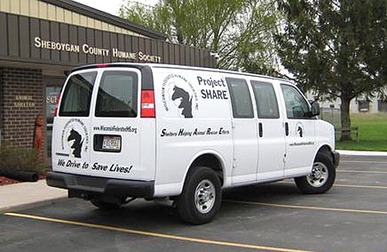
The new Wisconsin Federated Humane Societies, Inc. transport vehicle made its first Project SHARE trip on May 19, 2011, transporting five animals from Sheboygan County Humane Society to Fox Valley Humane Association in Appleton. The purpose of the Project SHARE transport system is to enable qualified WFHS Members to move animals from one Wisconsin shelter to another easily, thereby increasing chances of adoption and reducing euthanasia rates.
You'll see our new Project SHARE van, compliant with all of the ATCP 16 regulations for transporting animals, traveling all over Wisconsin as WFHS uses it to assist overpopulated shelters in transferring animals to shelters that have space.
Continue reading for Project SHARE Guidelines and links to printable Guidelines, a Fact Sheet, a Transport Application and Transportation Agreement forms.
We want your WFHS Transport experience to be a positive and productive one for all our members and, more importantly, for the animals.
To apply for a Project SHARE Transfer, please submit your application under the Help Wanted drop down.
Guidelines for Participation
COMMUNICATION – Be a Good Communicator
- Provide the WFHS Transport Coordinator (TC) with the name, cell phone number and email address of your transport contact person. During transports, this person must be readily available. WFHS Transport Drivers (TD) will communicate with your contact as necessary during transport.
- Provide the WFHS TC with your shelter address, phone number and hours you are available for pick-up and delivery.
- Provide the WFHS TC with accurate directions to your facility from major thoroughfares. (Remember to contact the WFHS TC if road construction will alter the normal routes)
- When arranging transports, inform the WFHS TC about any and all special conditions required to transport an animal safely and comfortably.
- If you need to change or cancel a WFHS transport, do so as soon as possible. (Failure to do so will result in termination of your shelter’s participation in the program)
RECORD KEEPING – Be Thorough with Records
- Have all records prepared for the WFHS Transport Driver upon arrival. The WFHS TD is running on a schedule and often has multiple stops to complete.
- All records and accompanying paperwork shall be in a clear plastic sleeve labeled with the Animal’s Name, ID Number, Description and Photo. These records should include:
- A Completed Animal Transport Document for each animal transported.
- A current Vaccination Record for each animal. Any animal 16 weeks or older is required to have proof of rabies vaccination prior to transport.
- Any additional Medical Records for each animal transported. Examples may include surgical history, heartworm testing, parasite treatment and daily medications for conditions like diabetes, seizures, heart disease, etc.
- Results of a thorough and competent Temperament/Behavior Assessment shall accompany the animal being transported.
- Special Notes/History of the Animal: Please include any special notes or additional information regarding the transported animal. Examples may include diet, likes and dislikes, etc. Please inform the WFHS TC and TD if the animal(s) being transported have a fear of crating or confinement or are a risk for flight.
- Whenever possible please note the brand of food currently being fed at your shelter in order to minimize GI upset at the receiving shelter.
- Provide all known medical and physical conditions regarding the animal being transferred to the WFHS TC. Be absolutely sure that these conditions have been disclosed to the recipient shelter to avoid any surprises or unexpected expenses (thereby keeping the doors of recipient shelters open to your animals).
- WFHS requires their Transport Drivers to carry emergency contact information on their dashboards. The animal records shall be placed with these documents. In the event of an emergency, these documents enable First Responders to access information about the animals on board.
- If a contagious medical condition presents after the animal(s) has arrived at the recipient shelter, please contact the WFHS TC and the shelter that sent the animal immediately. Animals with a known contagious disease shall not be transported in the same vehicle as healthy animals.
- Finally, review the passenger list with the WFHS TD upon exiting and entering your facility
- All animals being transported shall wear an identification band with their Names and ID Numbers clearly identified.
- All animals being transported shall be free of ectoparasites (fleas, ticks lice and earmites).
- All animals being transported should be clean (bathed and/or groomed) prior to transport.
- Choke Chain collars shall not be worn by animals during transport.
- Animals being transported should have food withheld the evening before and morning of transport (the exception being pocket pets, birds, rabbits and reptiles). This helps avoid elimination during transport and makes the trip more pleasant for the animals and the WFHS TD. Animals will be fed upon arrival at their destination shelter.
- Please be sure the animal(s) being transported have had ample time and opportunity to eliminate prior to transport.
- Animals should be provided with water prior to transport.
BUILDING PARTNERSHIPS – Be Honest in your Exchanges
- The WFHS Transport is not a system to move or “dump” marginal animals onto others. Always be completely honest about the description and condition of the animal(s) you are sending out. Misrepresenting the animal’s breed is unfair to the recipient shelter! Some breeds are more challenging for shelters to place and they have the right to decline an animal. Include information on how long an animal has been at your facility. NO ANIMAL with a bite case history will be transported.
- Help keep the doors of your partnering humane organizations open to your animals by being direct and honest about the condition, age, medical condition and temperament of the animals you are asking them to take. Once the transported animal has arrived at the recipient shelter, the destination is final and the end disposition is at the discretion of the recipient shelter.
- Remember we are all in this together and all have the same goals. We all want our animals to have the very best chance at a lifetime home so, please, please, please make sure that all your information about the pet is accurate.
SUCCESSFUL TRANSPORTS – Be Helpful and Courteous
- Shelter personnel shall be available to assist the WFHS TD in loading or unloading the animal(s). It is often best to bring crates inside for loading and unloading whenever possible. WFHS TD’s should not be expected to handle the animals or remove them alone.
- If the mammal, bird or reptile cannot be transferred to another crate or vehicle, the surrendering shelter will need to provide the cage or carrier. (Some reptiles require a secondary barrier for transport; a cage inside a crate may be helpful)
- If a specific temperature needs to be maintained for a particular animal (birds/reptiles) the surrendering shelter should relay this information to the WFHS TC when arranging for the transport. Please be sure the WFHS TD has this information also.
- In the event of a change in plans, it is extremely important that the shelters communicate promptly and fully with the WFHS TC and the WFHS TD. Your shelter partner in the exchange should also be notified immediately (no less that 12 hours is permissible). Deviations will result in your shelter’s participation being reevaluated.
- In most cases the WFHS TD has traveled a distance to arrive at your location. Please offer him/her a beverage, place to clean up and a restroom.
- Be sure to offer assistance with cleaning crates or carriers. Your WFHS TD may be picking up other animals for transport and will need clean and sanitized carriers for their transport.
- Always thank your WFHS TD for his/her assistance and ask if there is anything you can do to make the trip go smoothly.
HELP WITH EXPENSES – Be Generous
- Consider sending animals that are up-to-date with veterinary care and are altered. Animals that are vetted, clean and groomed can be placed up for adoption sooner by the recipient shelter.
- Offer crates and crate pads to the WFHS TD if you have them to spare. You may give up items when an animal leaves your shelter, but you will receive similar items when you receive an animal.
- Please consider making a monetary donation or the gift of a gas card to help offset the expenses of transport
_Animal Transfer Documents
WFHS Project Share Transport Guidelines (PDF)
WFHS Transport Fact Sheet (PDF)
WFHS Transport Application (PDF)
WFHS Transport Agreement (PDF)
Please contact Jennifer Blum for more information or transport details at jennifer.blum@hspcwi.org.
Disclaimer:
In the event of a large animal seizure, puppy mill, or a situation
involving law enforcement response, normal transport procedure my be
overruled or changed based on the circumstance between the originating
and recipient shelter(s).
*Please visit the Help Wanted link to request a Project SHARE transfer.
